This Week in B2B Tech: 18-22 May 2026
Ace

$82 billion at Nvidia, a $2 billion quantum cheque from Washington and a 23-out-of-25 Drupal warning set the tone for B2B tech this week. Buyers were not short of AI launches. They were short of certainty about who owns the data layer, where the compute comes from, which software platforms still deserve trust and how much work the new automation wave will actually remove. The signal was not cooling demand. It was visible dependency risk.
In parallel, influencer discussions circled the same commercial question from the demand side. Casey Newton asked whether the web is being "summarized to death", while Sarah Evans argued that buyers are now using AI to pick vendors and LinkedIn is feeding those answers. The creator thread was blunt: visibility is moving upstream from search results into AI answers, and brand trust now depends on what machines can read before a prospect ever reaches a website.
The next AI fight is over the enterprise data layer
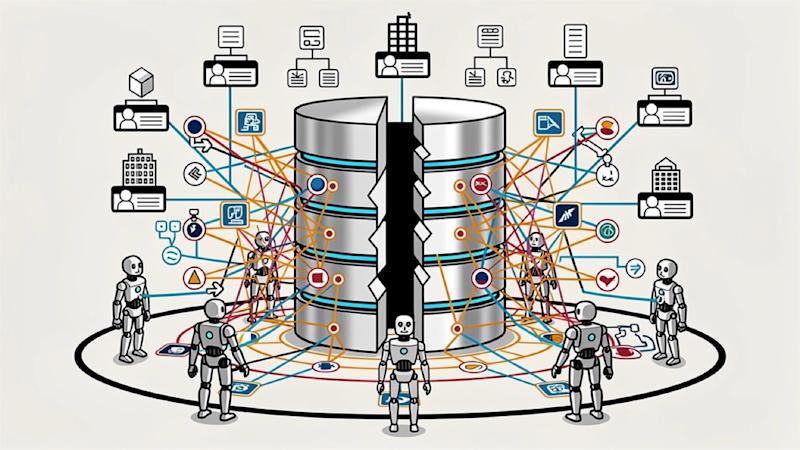
Microsoft and Databricks turned the semantic layer into the week's most revealing enterprise software row. The Information reported that Microsoft blocked a Databricks connector into Power BI after customers used it to manage the definitions that AI agents need to make sense of business metrics. Microsoft framed the move around accuracy and reliability. Rivals saw a platform owner defending the place where customer data becomes machine-readable context.
Several other stories pointed in the same direction. VentureBeat's D&B interview showed what happens when a 642 million-company database has to be rebuilt for agents rather than analysts, with entity resolution, MCP access and "Know Your Agent" checks becoming commercial infrastructure. Forbes put the same pressure on websites, arguing that AI-referred users arrive late in the buying journey and expect the page to confirm what the model already promised.
Search added the distribution layer. Google is pushing Shopping ads, Business Agent for Leads and Direct Offers into AI Mode, Search Engine Roundtable wrote, while its weekly recap noted new AI Mode formats, Google guidance on generative AI optimisation and Microsoft Clarity's citations report. The practical lesson for B2B vendors is uncomfortable: the website, the CRM, the analytics stack and the ad unit are no longer separate channels. They are evidence sources for agents, and whoever controls the definitions controls more of the buyer journey.
AI infrastructure moved from chip scarcity to power, heat and contracts

Nvidia's latest numbers gave the market its cleanest proof that AI spending is still running hot. CIO Dive reported $81.6 billion in quarterly revenue, up 85% year on year, with data centre revenue at $75.2 billion. Silicon Angle's read on the same results focused less on chips and more on Jensen Huang's phrase "AI factories", the idea that customers are buying an operating model for producing tokens, not a tray of GPUs.
The constraint has shifted. DCD's UK analysis put power and heat at the centre of the build-out, with AI racks commonly running at 60kW to 80kW and some specialist configurations exceeding 100kW. Legacy enterprise racks were closer to 5kW to 10kW. That is not a procurement delta. It changes site selection, grid planning, cooling, resilience and the financial case for every AI deployment that leaves a demo environment.
The week's deals made the point from the buyer side. Anthropic is reportedly talking to Microsoft about using Maia chips after already agreeing to buy $30 billion of Azure capacity, and OpenAI launched Guaranteed Capacity so customers can reserve long-term model compute for agents and workflows. Compute is becoming a forward contract. Boards that treat it as a monthly cloud bill will misprice both cost and availability.
Security debt showed up in the places AI now depends on

The week's security stories were not all AI stories, but they hit the systems AI programmes quietly rely on. Bleeping Computer reported active exploitation attempts against a highly critical Drupal SQL injection flaw, with the project scoring the risk 23 out of 25 and urging immediate updates across Drupal 8, 10 and 11 branches. A few hours earlier, Ubiquiti patched three maximum-severity UniFi OS flaws, with nearly 100,000 internet-exposed endpoints tracked by Censys.
Identity carried the sharpest warning. The Register covered an FBI warning on Kali365, a phishing-as-a-service kit stealing Microsoft OAuth tokens through device-code phishing and adversary-in-the-middle attacks. The pricing was almost offensively simple: $250 per month per tenant or $2,000 a year. The lower the cost of credential theft, the harder it is to sell AI transformation without tighter access controls.
Developer infrastructure also looked fragile. CSO wrote that an unpatched ChromaDB vulnerability could let unauthenticated attackers execute code by loading malicious model configurations from Hugging Face. SecurityWeek detailed Grafana's GitHub breach via the TanStack supply chain attack, while CNBC described how outages and security incidents have dented GitHub's AI coding advantage. The pattern is clear enough: AI raises the value of data, tokens, code and build systems, so attackers are following the value chain.
Governments tried to fund the future without losing control of it

Washington's $2 billion quantum package turned deep tech into industrial policy with an equity kicker. EE Times reported grants to nine quantum companies, including $1 billion for IBM and $375 million for GlobalFoundries, with some arrangements giving taxpayers minority equity stakes. Markets treated the signal seriously, and D-Wave shares jumped more than 35%.
The security clock is already running ahead of the commercial one. Computing covered NIST advancing nine post-quantum signature candidates into a third testing stage, adding to earlier standards such as Dilithium, Falcon and SPHINCS+. Buyers do not need to predict Q-Day to act. They need inventory, agility and a migration plan, because the algorithm set will keep changing before quantum machines become useful enough to break today's assumptions.
AI governance looked messier. The Guardian reported that Donald Trump postponed an executive order on advanced model review after saying he did not want to impede the US lead over China. In London, Sadiq Khan blocked a proposed £50 million Met Police AI deal with Palantir over procurement concerns. Meanwhile, Irish Tech News covered research on Big AI's influence over regulation, including 249 documented cases across major policy events. The state wants strategic technology, but it is still arguing about procurement, oversight and vendor dependence.
Enterprise AI started to separate durable software from replaceable work

Workday and Zoom gave traditional enterprise software a better week than the bears expected. Reuters reported Workday shares up nearly 12% premarket after revenue and profit beat estimates, with subscription revenue rising 14.3% to $2.35 billion. Zoom raised forecasts and authorised another $1 billion buyback, betting that AI features can keep meetings and communications sticky.
The more difficult story was labour. Standard Chartered's Bill Winters apologised after remarks about replacing "lower-value human capital" with AI drew backlash, Reuters wrote, while The Independent put the comments next to the bank's plan to cut around 7,800 jobs and reduce more than 15% of back-office roles by 2030. JPMorgan's Jamie Dimon called the wording "inartful" but told Bloomberg that "every app, every process, every job" will be affected, according to FinTech Magazine.
Fintech supplied the extreme case. Bolt's Ryan Breslow argued that removing HR made some problems disappear, part of a broader reset after the company's valuation fell 97% from its peak. Singapore's deputy prime minister took the counter-position, urging financial firms to ask what new roles AI can create, not only how much cost it can remove. The buyer implication is simple: AI adoption is now a workforce story as much as a product story, and clumsy language can become an operational risk.
What the influencers are discussing

The creator conversation was less excited by model releases than by the loss of old discovery habits. Sarah Evans captured the buyer-side shift in the cleanest line: "Your Buyers Are Using AI to Pick Vendors. LinkedIn Is Where It Gets Its Answers." That is a PR and marketing problem, not just a search problem. If AI systems draw answers from public expertise, profiles, third-party mentions and structured proof, then a quiet company becomes a weaker candidate before the sales team sees the lead. For comms teams, proof now has to be visible, repeated and attributed outside the owned site, not buried in gated PDFs now.
Casey Newton's Platformer question, "Is the web being summarized to death?", gave the media version of the same concern. His angle sat alongside the Google AI Mode coverage: if more queries resolve inside an answer box, publishers, analysts and vendors all have to work out what value is left on the destination page. Media Copilot took the measurement angle, arguing that Microsoft Clarity's citations tool gives publishers an early view of AI-driven discovery. That is narrow today, but commercially important. Citation visibility is becoming the new referral analytics.
Marketers were wrestling with what to call the discipline. Alex Lieberman's LinkedIn post was sceptical about AEO, describing it as "SEO for LLMs", while Dave Gerhardt's B2B marketing podcast treated answer-engine optimisation as an operating question for marketing leaders rather than a slogan. The tension is healthy. AEO will get abused by vendors, but the underlying work is real: make claims machine-readable, earn independent mentions, refresh proof points and know which questions your buyers ask before they search.
There was also a useful backlash against agentic hype. David Linthicum warned that the industry's buzzword cycle risks repeating the cloud-native and microservices years, when packaging often outran architecture. That scepticism pairs well with the week's enterprise data stories. Agents are not magic workers. They need definitions, identity, permissions, latency, audit trails and content that survives contact with a buying committee. The influencers who cut through this week were the ones treating AI visibility as plumbing, not theatre.
The open question is whether buyers will reward the companies doing the unglamorous work first. The week suggested they should. AI agents need clean definitions, compute contracts need realistic power plans, security teams need to assume tokens and build systems are prizes, and executives need a workforce narrative that survives scrutiny. None of that fits a launch keynote neatly. It is where next week's budgets will be fought.
References
- (The Information, "Microsoft Opens a New Front in the Fight Over Data for AI Agents")
- (VentureBeat, "D&B's database of 642 million businesses was built for humans, not AI agents. So they rebuilt it.")
- (Forbes, "Your Website Is Decaying Consumer Intent Faster Than You Think")
- (Search Engine Roundtable, "Google AI Mode Shopping Ads, Business Agent For Leads & Direct Offers Coming")
- (Search Engine Roundtable, "Search News Buzz Video Recap: Google's New Search Box, Gemini 3.5 Flash Powers AI Mode, New Google Ads, Ranking Volatility & More I/O GML News")
- (CIO Dive, "Nvidia revenue jumps 85% on AI infrastructure demand")
- (Silicon Angle, "Five takeaways from Nvidia's earnings, and what they mean for the AI industry")
- (DCD (DatacenterDynamics), "AI growth is running into a power and heat constraint")
- (DCD (DatacenterDynamics), "Anthropic in talks to use Microsoft's custom Maia AI chips - report")
- (DCD (DatacenterDynamics), "OpenAI launches "Guaranteed Capacity" offering, giving customers ability to secure long-term access to compute")
- (Bleeping Computer, "Drupal: Critical SQL injection flaw now targeted in attacks")
- (Bleeping Computer, "Ubiquiti patches three max severity UniFi OS vulnerabilities")
- (The Register, "FBI warns Kali365 phishing kit is stealing Microsoft OAuth tokens at scale")
- (CSO, "Unpatched ChromaDB flaw leaves servers open to remote code execution")
- (SecurityWeek, "Grafana Says Codebase and Other Data Stolen via TanStack Supply Chain Attack")
- (CNBC Technology, "Microsoft's GitHub was positioned to win the AI coding race. Outages got in the way")
- (EE Times, "U.S. Injects $2B into Quantum Computing Companies")
- (Computing, "NIST advances new wave of quantum-safe signature algorithms")
- (The Guardian, "Trump postpones executive order on AI over China concerns – US politics live")
- (Computing, "Sadiq Khan blocks Met's £50m AI deal with Palantir")
- (Irish Tech News, "Big AI's control of narrative and regulation poses significant threat to rule of law")
- (Reuters Technology, "Workday shares jump as AI demand eases investor concerns")
- (Reuters Technology, "Zoom raises annual forecasts, banks on AI features to drive demand")
- (Reuters Technology, "StanChart CEO apologises for 'upset caused' by AI comments")
- (The Independent, "Standard Chartered boss sorry after saying AI would replace ‘lower-value human capital’ amid job cuts")
- (FinTech Magazine, "AI to Transform Every Role in Banking, JPMorgan's Dimon says")
- (FinTech Magazine, "Why Bolt's CEO Bets on AI Over HR in Company-Wide Reset")
- (FStech, "Singaporean deputy PM: Financial firms must use AI to create jobs")
- (Sarah Evans, "Your Buyers Are Using AI to Pick Vendors. LinkedIn Is Where It Gets Its Answers.")
- (Platformer, "Is the web being summarized to death?")
- (Media Copilot, "Microsoft Clarity's new Citations tool gives publishers their first real window into AI-driven discovery")
- (Alex Lieberman, "I thought AEO (read: SEO for LLMs) was a hunk of bullsh*t.")
- (Dave Gerhardt, "How Marketing Leaders are Thinking About AEO")
- (David Linthicum, "The technology industry's fascination with buzzwords like 'agentic AI' mirrors past trends")